Port of Spain · Trinidad and Tobago
Archbishop’s Palace
Ecclesiastical landmark with Indian Empire influences
Explore this place / Introduction
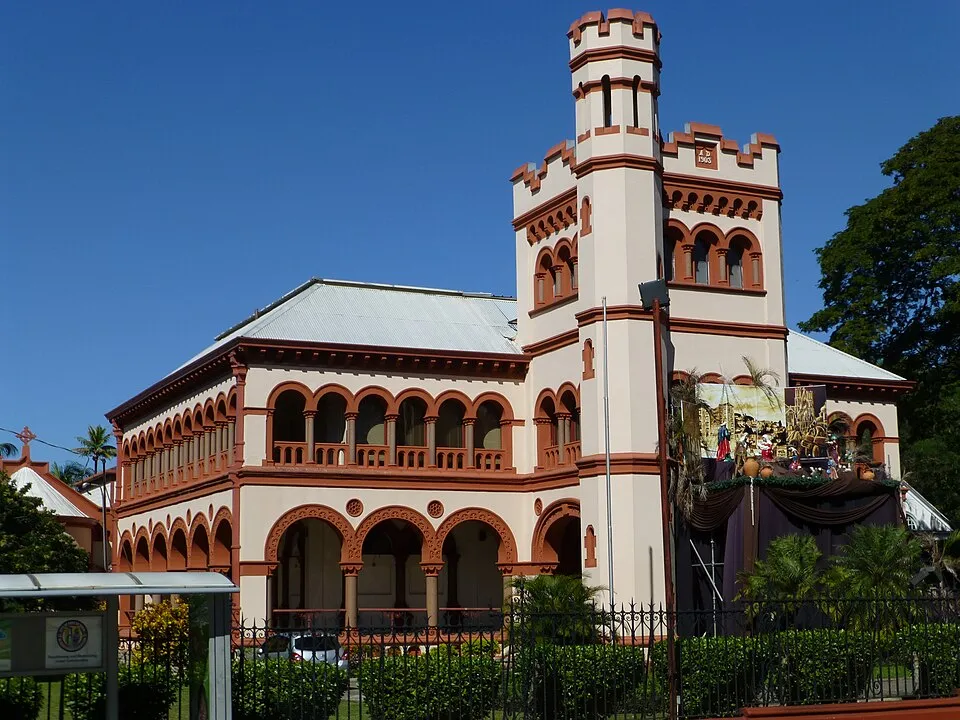
The Archbishop’s Palace is one of the seven notable buildings lining the Savannah’s western approach. Its ceremonial architecture gives the row a distinctly ecclesiastical dimension.
An ecclesiastical residence commissioned in 1903 by Archbishop Patrick Vincent Flood.
About this place and its management · Archbishop’s Palace
Residence associated with the Roman Catholic Archbishop of Port of Spain; listed by the National Trust.
The palace remains associated with the Roman Catholic Archdiocese of Port of Spain and its archbishop. National Trust recognition concerns its heritage significance; church use and visitor permissions are distinct matters. Do not assume access to the residence or grounds.
Archbishop Patrick Vincent Flood commissioned the residence in 1903, during a period of ambitious house-building along Maraval Road.
Visit advice and highlights
What to notice
View the building respectfully from the public sidewalk, noting how its ecclesiastical role differs from the neighbouring private mansions and civic offices.
Photography and visitor tips
Frame the full elevation from a safe street-side location and avoid religious or private activity.
Plan your visit
Compare the palace’s ceremonial style with Roomor and Whitehall in a single west-side stroll.
Suggested duration: Plan 15–25 minutes for the façade.
Essential information
An ecclesiastical residence commissioned in 1903 by Archbishop Patrick Vincent Flood.
- Address
- Maraval Road, St. Clair, Port of Spain, Trinidad and Tobago
- Opening / access
- Official ecclesiastical residence; exterior observation only unless authorized
- Admission
- Public-road façade views are free; interior entry is not general sightseeing
- About this place and its management
- Residence associated with the Roman Catholic Archbishop of Port of Spain; listed by the National Trust.
- Suggested duration
- Plan 15–25 minutes for the façade.
- Access and visitor rules
- The building is an ecclesiastical residence, not a public museum. Interior access requires authorization.
- Walking and local transport
- Follow public sidewalks along Maraval Road from the western Savannah perimeter.
- Official source and current arrangements
- National Trust of Trinidad and Tobago
Opening / access
Official ecclesiastical residence; exterior observation only unless authorized
The building is an ecclesiastical residence, not a public museum. Interior access requires authorization.
Official source and current arrangementsTickets and pricing
Public-road façade views are free; interior entry is not general sightseeing
Getting there
Follow public sidewalks along Maraval Road from the western Savannah perimeter.
From Queen’s Park Savannah, use its perimeter as your orientation point. Walk via designated crossings or take a local taxi; road access and traffic change during events.
History, architecture and culture
About and historical background
Archbishop Patrick Vincent Flood commissioned the residence in 1903, during a period of ambitious house-building along Maraval Road.
Architecture and highlights
National Trust materials note Indian Empire architectural influences. Look for the building’s silhouette, decorative treatment and relationship to the garden frontage.
What to notice
View the building respectfully from the public sidewalk, noting how its ecclesiastical role differs from the neighbouring private mansions and civic offices.
What makes this site distinct
An ecclesiastical residence commissioned in 1903 by Archbishop Patrick Vincent Flood.
History, architecture and culture: Archbishop’s Palace
Archbishop Patrick Vincent Flood commissioned the residence in 1903, and George Brown of the Trinidad Trading Company completed the building in 1904. The project coincided with the development of grand houses by wealthy families along the Savannah, but its enduring purpose was ecclesiastical.
Look for the Indian Empire influence cited by the National Trust, especially in the roof profile and decorative rhythm. Observe how the setback and landscaped frontage create a ceremonial approach, rather than treating it as simply another mansion. Frame photographs from public space with the full façade in view.
Suggested visit route
- Approach the Savannah’s western heritage strip.
- Find the Archbishop’s Palace on Maraval Road.
- Observe details from the permitted pavement.
- Compare adjacent Roomor and Whitehall exteriors.
Before you go
The building is an ecclesiastical residence, not a public museum. Interior access requires authorization.
View the building respectfully from the public sidewalk, noting how its ecclesiastical role differs from the neighbouring private mansions and civic offices.
Recommended photo viewpoints
Stand back on a safe sidewalk to include the roof silhouette and garden frontage.
Frame the full elevation from a safe street-side location and avoid religious or private activity.
Photos of this attraction
Questions before visiting
- Who commissioned it? Archbishop Patrick Vincent Flood.
- When? In 1903.
- Can tourists enter? No unrestricted public access should be assumed.
Where to stay
St. Clair offers convenient access to the historic mansion row.
Port of Spain and St. Clair offer lodging options for visitors planning to explore the Savannah and nearby cultural attractions. Compare current access and transport before booking.
Visitor ratings and reviews
For the current Google Maps rating, review count and individual visitor opinions, open this place’s own listing. No unverified rating is reproduced here.
Read reviews for this placeLocation and navigation
Maraval Road, St. Clair, Port of Spain, Trinidad and Tobago
View this attraction on Google Maps