Port of Spain · Trinidad and Tobago
Ambard’s House (Roomor)
French Second Empire influences in a lived-in heritage home
Explore this place / Introduction
Roomor sits between neighbouring Magnificent Seven mansions along Maraval Road. Unlike a museum, it remains a lived-in family residence with a remarkably intact historic character.
A private 1904 French Second Empire-influenced house, also known as Roomor.
About this place and its management · Ambard’s House (Roomor)
Privately owned by the Roodal/Morgan family according to the National Trust; Grade 1 listed heritage property.
Roomor is a privately occupied home and not a walk-in museum. The National Trust records its heritage value and restricted entry; residents control access to the property. Visitors should remain outside gates and boundary walls.
Lucien F. Ambard built the house in 1904. Later owners included the Roodal family; the name Roomor combines Roodal and Morgan.
Visit advice and highlights
What to notice
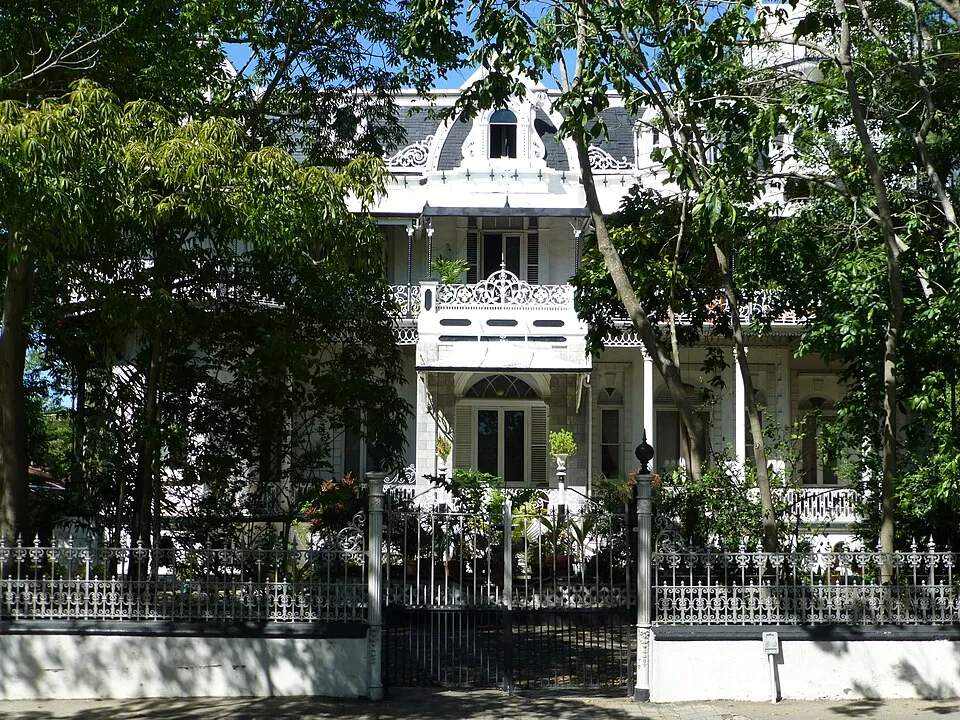
Look for roof forms, decorative iron and the relationship between the house and its garden frontage. Respect the private property line and compare it with Mille Fleurs.
Photography and visitor tips
An oblique street-side composition reveals the roofline without blocking private access.
Plan your visit
Read the ornate roof and ironwork against the neighbouring Mille Fleurs and Archbishop’s Palace.
Suggested duration: Allow around 15–25 minutes for exterior observation.
Essential information
A private 1904 French Second Empire-influenced house, also known as Roomor.
- Address
- Lot 25 Maraval Road, St. Clair, Port of Spain, Trinidad and Tobago
- Opening / access
- Occupied private home; exterior views only
- Admission
- No ticket for public-road exterior views; no unrestricted interior access
- About this place and its management
- Privately owned by the Roodal/Morgan family according to the National Trust; Grade 1 listed heritage property.
- Suggested duration
- Allow around 15–25 minutes for exterior observation.
- Access and visitor rules
- The National Trust describes a lived-in private home with restricted access; use public-sidewalk viewpoints only.
- Walking and local transport
- Approach Lot 25 Maraval Road from the Savannah’s western side on foot.
- Official source and current arrangements
- National Trust of Trinidad and Tobago
Opening / access
Occupied private home; exterior views only
The National Trust describes a lived-in private home with restricted access; use public-sidewalk viewpoints only.
Official source and current arrangementsTickets and pricing
No ticket for public-road exterior views; no unrestricted interior access
Getting there
Approach Lot 25 Maraval Road from the Savannah’s western side on foot.
From Queen’s Park Savannah, use its perimeter as your orientation point. Walk via designated crossings or take a local taxi; road access and traffic change during events.
History, architecture and culture
About and historical background
Lucien F. Ambard built the house in 1904. Later owners included the Roodal family; the name Roomor combines Roodal and Morgan.
Architecture and highlights
Its French Second Empire design used imported Italian marble, French tiles and Scottish cast iron, while roof timbers came from the Ambard family’s Erin estate.
What to notice
Look for roof forms, decorative iron and the relationship between the house and its garden frontage. Respect the private property line and compare it with Mille Fleurs.
What makes this site distinct
A private 1904 French Second Empire-influenced house, also known as Roomor.
History, architecture and culture: Ambard’s House (Roomor)
Lucien F. Ambard commissioned the family home in 1904. The National Trust records that financial difficulties led to the loss of the house in 1919. Its later name, Roomor, preserves another chapter of the property’s changing ownership while the building remains a lived-in residence.
Contrast the elaborate roofline and ornamental iron with the more balanced French-inspired façade of nearby Mille Fleurs. Move only along permitted pavement to compare the changing silhouettes. The contrast between exuberant decoration and everyday private use is part of what makes Roomor distinctive.
Suggested visit route
- Walk west of the Savannah towards Maraval Road.
- Locate Lot 25 between the other historical mansions.
- Study the roof and decorative details from the public sidewalk.
- Continue to Archbishop’s Palace and Whitehall.
Before you go
The National Trust describes a lived-in private home with restricted access; use public-sidewalk viewpoints only.
Look for roof forms, decorative iron and the relationship between the house and its garden frontage. Respect the private property line and compare it with Mille Fleurs.
Recommended photo viewpoints
A street-side angle shows the roof shape and the relationship to its frontage.
An oblique street-side composition reveals the roofline without blocking private access.
Photos of this attraction
Questions before visiting
- Why is it called Roomor? From Roodal and Morgan.
- Can I tour inside? No open public access is listed.
- Which architectural style? French Second Empire influences.
Where to stay
Stay around St. Clair for a compact architecture circuit.
Port of Spain and St. Clair offer lodging options for visitors planning to explore the Savannah and nearby cultural attractions. Compare current access and transport before booking.
Visitor ratings and reviews
For the current Google Maps rating, review count and individual visitor opinions, open this place’s own listing. No unverified rating is reproduced here.
Read reviews for this placeLocation and navigation
Lot 25 Maraval Road, St. Clair, Port of Spain, Trinidad and Tobago
View this attraction on Google Maps